
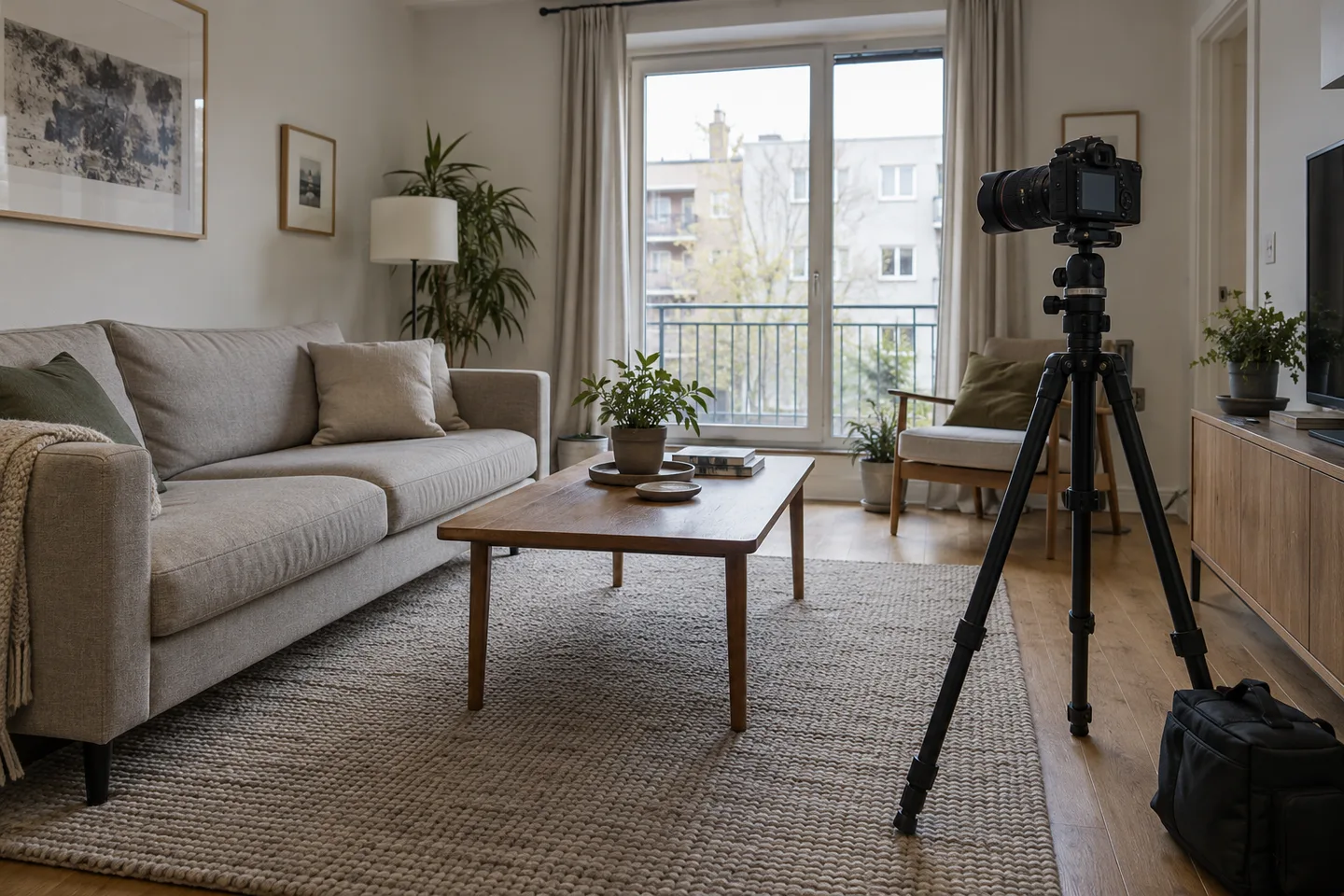
Two thousand images may repeat the same frontal view while leaving the side of an armrest or an occlusion boundary weakly constrained. Inspect image quality, SfM poses, sparse geometry and novel-view rendering separately. The number in this title is a scenario, not a quality threshold or a reported Visuloma experiment.
Repeated frontal photos do not reveal the side
Rotating a camera from one position changes its viewing direction without necessarily creating enough camera-center displacement. A small slide across the front of a sofa is different from a view that actually reveals the side of its armrest.
A useful capture balances matchable overlap with views that constrain depth and reveal occlusions. There is no universal image count or angle that guarantees success. Plain walls, glass, repeated textures and thin furniture legs need separate inspection.
Top view · dots: cameras · lines: viewing directions
Repeated front views leave the sides weakly observed. More images from the same region do not guarantee useful depth constraints.
Views around the sofa add observations of its sides. Useful overlap, texture and accurate camera poses are still required.
Conceptual illustration, not a model result or a measured comparison.
Identify the failing stage
Start with the inputs: check whether blur, clipping or moving people cluster around the damaged region. Then inspect registration, camera-path continuity and disconnected SfM models. Next inspect local sparse support rather than only the total point count.
Finally compare trained views with held-out views. Sharp training images with unstable novel views require a different response from geometry that is misaligned everywhere. Successful registration does not certify every surface.
Design a targeted sofa recapture
Mark the armrest front, side, back and underside on a sketch. Preserve the original dataset. Reconstruct a small, well-covered subset, then a second version adding only the missing views. Keep output resolution, training budget and evaluation path comparable.
Do not delete every visually similar image: some may connect two capture segments. Preserve connectivity while filtering. This is an experimental design, not a claim that a sofa dataset has already demonstrated an improvement.
Photo selection needs reasons, not just a score
Useful outputs explain blur, missing side coverage, disconnected camera graphs or possible bridge images. A single-image aesthetic score cannot evaluate multi-view geometry.
A future Visuloma screening workflow should first define datasets and failure criteria, then record review effort, recapture frequency and held-out-view quality. Test each filtering step against that baseline. This is a research direction, not an advertised existing product.
Sources and scope
Research synthesis and a proposed diagnostic workflow. Not an unprovided Visuloma case study or benchmark.
Sources checked on 16 October 2026. Capture conditions, methods and versions affect applicability.